

Green Careers UK options are multiplying across various sectors as the nation restructures its economy to meet statutory decarbonisation targets. Rather than functioning as a single, uniform employment category, ecological employment spans multiple distinct vocational groups with vastly different technical requirements. Recent findings by the Climate Change Committee (2024) Progress Report to Parliament highlight that while strategic ambitions are expanding, labour market capacity must catch up rapidly. Understanding this transformation requires looking past generic slogans and examining how specific professional clusters are evolving. Methodical analysis shows that recruitment demand is clustering around several core capability areas rather than appearing evenly across all industries.
The transition cannot be understood without acknowledging that employment patterns are shifting under regulatory pressures similar to those seen in UK employment law changes, where compliance dictates operational change. Employers are no longer testing the waters with pilot schemes; they are integrating sustainability metrics into core business functions. This operational reality demands a structured breakdown of the actual work being generated across the British economy. Let us examine the five primary career families driving this structural evolution.
Engineering and Technical Trades
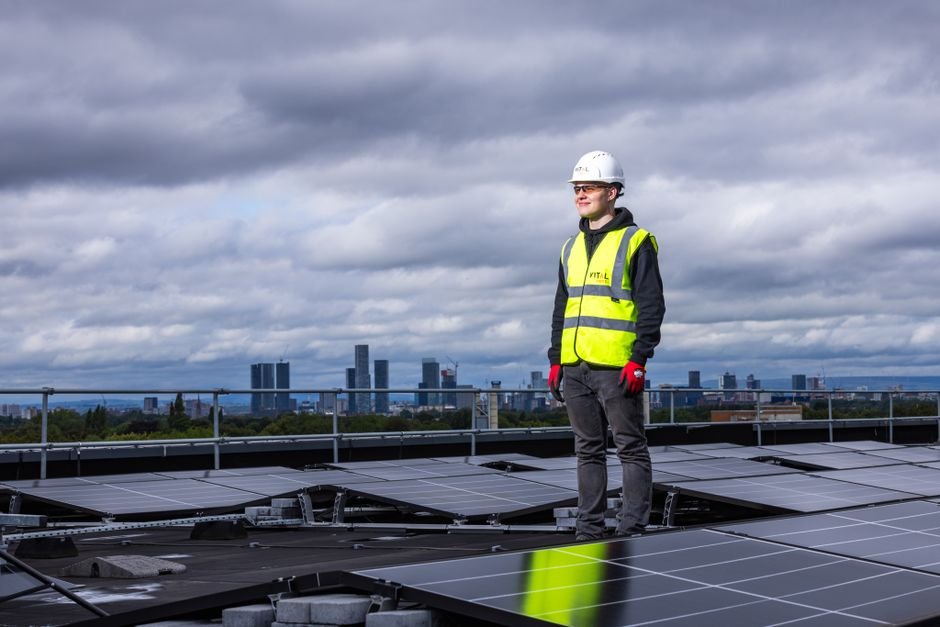
Engineering and technical trades form the physical bedrock of the low-carbon economy, focusing heavily on infrastructure retrofitting and grid reinforcement. Current hiring evidence shows a clear surge in demand for heating engineers qualified in heat pump installation, electrical technicians for EV charging networks, and retrofit coordinators. These roles require a solid foundation in traditional mechanical or electrical engineering, supplemented by specialised accreditations. Entry routes typically involve vocational qualifications, NVQs, or upskilling programmes designed for established tradespeople wishing to transition. Transferable skills from conventional construction and manufacturing include fault diagnosis, spatial awareness, and adherence to rigorous health and safety protocols.
The Climate Change Committee (2024) Progress Report to Parliament notes that workforce gaps in these technical domains remain one of the most significant bottlenecks to meeting domestic decarbonisation timelines. Employers are frequently forced to poach experienced staff or invest heavily in internal academies. This supply constraint means that compensation packages for certified technicians are rising faster than the national average across comparable non-green trades. Professionals looking to enter this space should focus on acquiring specific micro-credentials rather than starting entirely new degrees, leveraging their foundational hand-skills.
Project and Operations Roles
Project and operations roles manage the complex delivery of capital-intensive clean energy infrastructure and large-scale industrial decarbonisation projects. Current hiring evidence demonstrates strong employer demand for renewable energy project managers, site supervisors, and supply chain coordinators. These practitioners oversee the transition of offshore wind farms, solar arrays, and industrial hydrogen facilities from blueprint to operational reality. Entry routes usually involve a background in traditional project management, civil engineering, or logistics, supported by industry-recognised certifications like PRINCE2 or APM. Transferable skills include risk mitigation, stakeholder management, budget tracking, and navigating intricate planning permission frameworks.
While forecasts suggest exponential long-term growth in project management capacity, current hiring remains closely tied to secured capital funding and government approvals. Professionals transitioning into these operational positions often find that their core organisational abilities matter more than prior niche knowledge of renewable technologies. As regulatory frameworks shift, personnel who understand how to align operational delivery with compliance mandates are exceptionally valued by corporate boards. Organizations are also aligning these workforce demands with regional strategies, mirroring trends observed in Greater Manchester jobs and skills initiatives.
Data and Digital Roles
Data and digital roles provide the analytical intelligence required to manage decentralized energy grids, monitor carbon emissions, and optimize resource efficiency. Current hiring evidence indicates robust recruitment for smart grid data analysts, carbon accountants, and geographic information system specialists. These experts process massive streams of telemetry data from smart meters, weather stations, and industrial sensors to balance supply and demand in real time. Entry routes generally feature degrees in computer science, data analytics, mathematics, or environmental science with a strong quantitative component. Transferable skills include database management, predictive modelling, statistical programming languages like Python or R, and data visualisation.
The Climate Change Committee (2024) Progress Report to Parliament emphasizes that real-time data transparency is essential for tracking progress against legally binding carbon budgets. Consequently, organizations across utilities, finance, and manufacturing are competing for digital talent that can translate raw metrics into actionable corporate strategy. Unlike physical engineering roles, digital professionals can often transition from other data-heavy sectors like fintech or telecommunications with minimal re-tooling. This fluid movement of technical talent helps alleviate immediate skills shortages in the digital sustainability space.
Finance and Commercial Roles
Finance and commercial roles channel capital toward sustainable assets while ensuring regulatory compliance and managing long-term financial risk. Current hiring evidence highlights high demand for ESG analysts, sustainable finance managers, and green procurement specialists within major banking institutions and corporate treasuries. These practitioners evaluate investment portfolios for climate-related risks, structure green bonds, and ensure supply chains meet stringent environmental standards. Entry routes include traditional finance qualifications, accounting credentials, and economics degrees, increasingly supplemented by sustainable finance certificates such as the CFA ESG investing credential. Transferable skills encompass financial modeling, risk assessment, auditing, and regulatory reporting.
The integration of sustainability into commercial operations mirrors the administrative rigor seen when companies adapt to flexible working rights or other sweeping employment mandates. Commercial leaders must balance profitability with rigorous environmental disclosures, requiring a workforce that understands both ledgers and carbon accounting. As mandatory climate-related financial disclosures become standard practice for British firms, the talent pipeline for these commercial roles must expand rapidly. Candidates with strong quantitative backgrounds find that their core financial acumen is directly transferable to these emerging market demands.
Policy and Regulation Roles
Policy and regulation roles shape the legislative boundaries within which businesses operate, ensuring that national targets translate into actionable corporate governance. Current hiring evidence shows steady demand for sustainability consultants, regulatory affairs officers, and public policy advisors across both the public and private sectors. These specialists interpret emerging legislation, lobby government bodies on behalf of industry associations, and design internal compliance frameworks. Entry routes typically involve backgrounds in law, public administration, economics, or environmental policy, often backed by postgraduate qualifications. Transferable skills include legal drafting, stakeholder negotiation, analytical writing, and complex problem-solving.
The Climate Change Committee (2024) Progress Report to Parliament underscores the vital role that coherent policy frameworks play in driving private sector investment and workforce planning. Without clear regulatory signals, businesses hesitate to commit capital or hire specialized personnel at scale. Professionals in this category act as the bridge between legislative intent and corporate execution, making their analytical capabilities indispensable. Navigating these overlapping regulatory demands requires a methodical approach to compliance that safeguards organizational stability while meeting national net zero objectives.
References
Climate Change Committee. 2024. Progress Report to Parliament. London: Climate Change Committee.